📘 What is an Ideal Gas?
An ideal gas is a theoretical gas composed of randomly moving point particles that interact only through elastic collisions. It perfectly obeys the gas laws under all conditions. Real gases (O₂, N₂, CO₂) behave like ideal gases at low pressure and high temperature, but deviate at high pressure and low temperature.
📐 Boyle's Law (1662)
At constant temperature, the pressure of a fixed amount of gas is inversely proportional to its volume.
P ∝ 1/V or PV = constant (at constant T and n)
P₁V₁ = P₂V₂
Also called isothermal law. If volume doubles, pressure halves. Graph: P vs V is hyperbolic; P vs 1/V is straight line through origin.
🌡️ Charles' Law (1787)
At constant pressure, the volume of a fixed amount of gas is directly proportional to its absolute temperature (Kelvin).
V ∝ T or V/T = constant (at constant P and n)
V₁/T₁ = V₂/T₂
Also called isobaric law. At -273.15°C (absolute zero), the volume of an ideal gas becomes theoretically zero. This is the basis of the Kelvin scale.
🔥 Gay-Lussac's Law
At constant volume, the pressure of a fixed amount of gas is directly proportional to absolute temperature.
P ∝ T or P/T = constant (at constant V and n)
P₁/T₁ = P₂/T₂
Also called isochoric law. Explains why aerosol cans burst when heated.
🧪 Avogadro's Law (1811)
At constant temperature and pressure, equal volumes of all gases contain equal number of molecules.
V ∝ n (at constant T and P)
One mole of any gas at STP occupies exactly 22.4 liters (molar volume).
🧮 Ideal Gas Equation
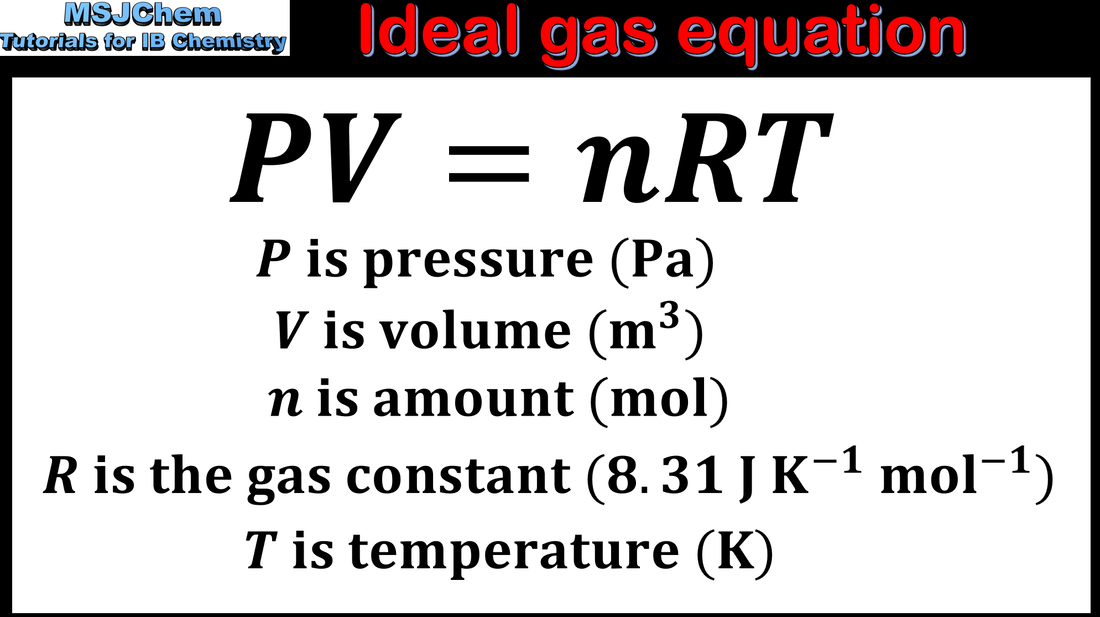
Combining Boyle's, Charles', and Avogadro's laws gives the master equation:
P = Pressure | V = Volume | n = Number of moles | R = Universal gas constant | T = Temperature (Kelvin)
Values of R:
- 8.314 J/mol·K (SI unit)
- 0.0821 L·atm/mol·K (when P in atm, V in L)
- 1.987 cal/mol·K (in calories)
- 62.36 L·mmHg/mol·K (when P in mmHg)
Applications: Find moles (n = PV/RT), density (ρ = PM/RT), molar mass (M = mRT/PV).
📏 Combined Gas Law
When the amount of gas is constant, all three variables (P, V, T) are related:
P₁V₁/T₁ = P₂V₂/T₂
🔬 Kinetic Molecular Theory of Gases
This theory explains WHY gases follow the above laws based on molecular behavior:
- Gases consist of tiny particles (atoms/molecules) in constant, random motion.
- The volume of particles is negligible compared to the total gas volume.
- There are no attractive or repulsive forces between particles.
- Collisions between particles and with walls are perfectly elastic (no energy loss).
- Average kinetic energy ∝ absolute temperature: KE = (3/2)nRT or KE = (3/2)kT per particle.
💨 Graham's Law of Diffusion/Effusion
The rate of diffusion/effusion of a gas is inversely proportional to the square root of its molar mass.
r₁/r₂ = √(M₂/M₁)
Lighter gases (H₂, He) diffuse faster than heavier gases (O₂, CO₂).
📊 Dalton's Law of Partial Pressures
The total pressure of a gas mixture equals the sum of partial pressures of each individual gas.
Ptotal = P₁ + P₂ + P₃ + ...
Partial pressure of a gas = mole fraction × total pressure: Pᵢ = (nᵢ/ntotal) × Ptotal
📐 Root Mean Square (RMS) Velocity
vrms = √(3RT/M) where M is molar mass in kg/mol.
RMS velocity ∝ √T and ∝ 1/√M. At same temperature, lighter gases move faster.
🌍 STP, NTP, and SATP
| Standard | Temperature | Pressure | Molar Volume |
|---|---|---|---|
| STP | 0°C (273.15 K) | 1 atm | 22.4 L |
| NTP | 20°C (293.15 K) | 1 atm | ~24 L |
| SATP | 25°C (298.15 K) | 1 bar | ~24.8 L |
⚠️ Real Gases vs Ideal Gases
Real gases deviate from ideal behavior at high pressure (particles too close, volume significant) and low temperature (attractive forces become important). The van der Waals equation corrects for this: (P + an²/V²)(V - nb) = nRT where 'a' corrects for attractive forces and 'b' for molecular volume.
💡 Exam Quick Points
- PV = nRT — Master equation
- R (SI) = 8.314 J/mol·K | R (L·atm) = 0.0821
- Molar volume at STP = 22.4 L
- Boyle's: PV = constant (isothermal)
- Charles': V/T = constant (isobaric)
- Gay-Lussac's: P/T = constant (isochoric)
- Avogadro's: V ∝ n at constant T,P
- KE per mole = (3/2)RT
- Graham's: r₁/r₂ = √(M₂/M₁)
- Dalton's: Ptotal = ΣPi
- Absolute zero: -273.15°C = 0 K
- Density: ρ = PM/RT
📖 Revision Complete! Click above to begin the quiz.
💨 Ideal Gas MCQ Quiz
NEB / CEE Chemistry • 40 Questions • 45 Minutes