🎵 Focus Music Playing
📘 Introduction
The periodic table is chemistry's greatest organizational tool. With 118 elements, classification helps us understand trends and predict properties. The journey spans from Dobereiner's Triads (1817) to Moseley's Modern Periodic Law (1913).
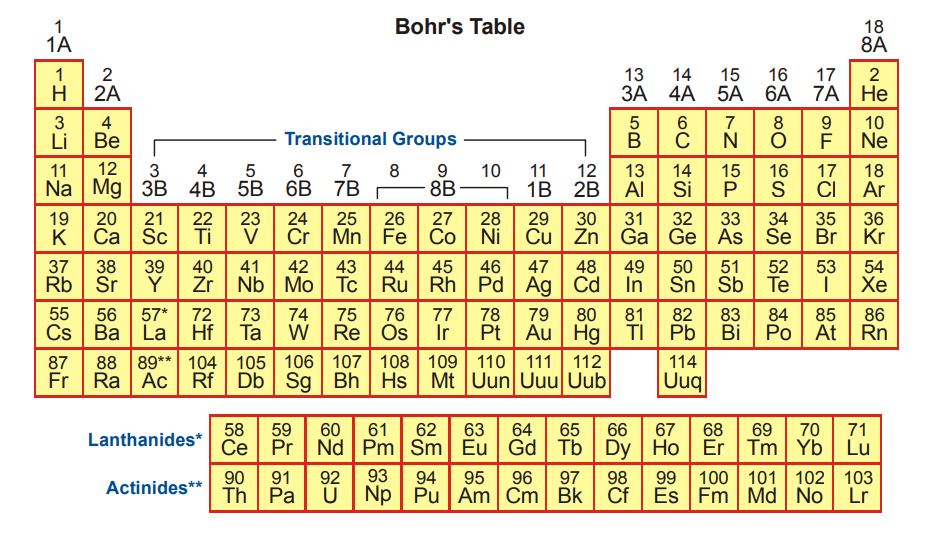
📌 Figure 1: Modern Periodic Table of Elements (Source: Wikipedia)
🏗️ Structure of Modern Periodic Table
7 Periods (horizontal rows) and 18 Groups (vertical columns, IUPAC 1-18). Elements are arranged by increasing atomic number. Blocks: s (Groups 1-2), p (13-18), d (3-12), f (lanthanides & actinides).
📈 Periodic Trends Summary
| Property | Across Period → | Down Group ↓ |
|---|---|---|
| Atomic Radius | Decreases | Increases |
| Ionization Energy | Increases | Decreases |
| Electron Affinity | Increases (more -ve) | Decreases |
| Electronegativity | Increases | Decreases |
| Metallic Character | Decreases | Increases |
| Zeff | Increases | ~Constant |
💡 Key Exam Points
- Modern periodic law: Properties are periodic functions of atomic number (Moseley)
- Zeff = Z - σ
- IE exception: N > O (half-filled p³ stability); Be > B
- EA max: Chlorine (not fluorine) due to small F size
- EN max: Fluorine (4.0 Pauling scale)
- Noble gases: Zero electron affinity
- Isoelectronic: N³⁻ > O²⁻ > F⁻ > Na⁺ > Mg²⁺ > Al³⁺
- Diagonal relationship: Li-Mg, Be-Al, B-Si
🧪 Periodic Table & Classification MCQ
NEB / CEE Chemistry • 75 MCQs • 5 Rounds of 15
📊 Overall Progress0%