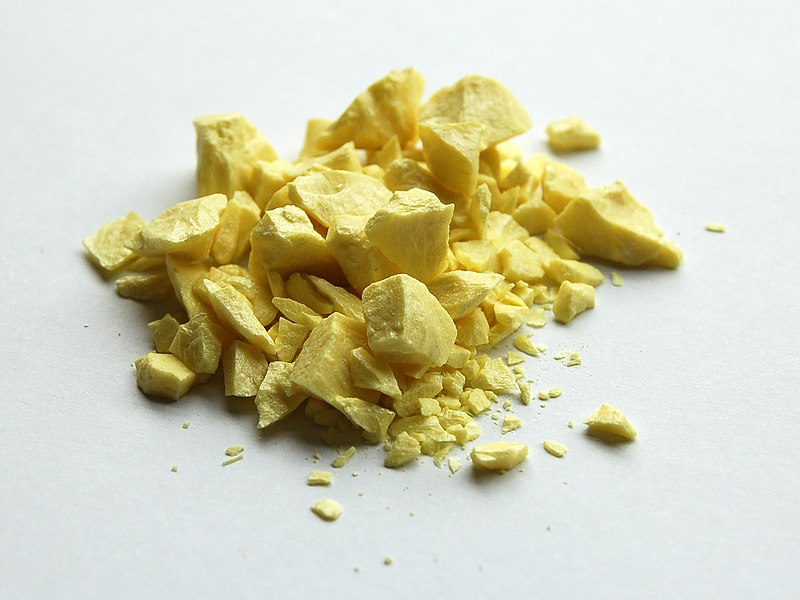
📌 Figure: Native sulphur crystals (Image: Wikipedia)
📘 Introduction to Sulphur
Sulphur is a non-metallic element with the symbol S and atomic number 16. It belongs to Group 16 (VIA) and Period 3 of the modern periodic table. The group is also known as the Chalcogen family (oxygen family), which includes oxygen, sulphur, selenium, tellurium, and polonium.
Sulphur is the second member of the oxygen family. Its electronic configuration is 1s² 2s² 2p⁶ 3s² 3p⁴, with 6 valence electrons. It commonly exhibits oxidation states of -2, +4, and +6.
In nature, sulphur is found both in free state (volcanic regions, underground deposits) and in combined state as sulphides (e.g., iron pyrite FeS₂, galena PbS), sulphates (e.g., gypsum CaSO₄·2H₂O, epsom salt MgSO₄·7H₂O), and in organic compounds like proteins (amino acids cysteine and methionine).
💎 Allotropes of Sulphur
Sulphur exhibits allotropy, meaning it exists in different physical forms. The three main allotropes are:
1. Rhombic Sulphur (α-Sulphur)
Also called octahedral sulphur. It is the most stable form at room temperature. It forms pale yellow, octahedral crystals with a melting point of 113°C. It is insoluble in water but soluble in carbon disulphide (CS₂). Transition temperature to monoclinic sulphur is 96°C.
2. Monoclinic Sulphur (β-Sulphur)
Also called prismatic sulphur. It is stable above 96°C. It forms long, needle-shaped crystals with a melting point of 119°C. It slowly converts back to rhombic sulphur when cooled below 96°C.
3. Plastic Sulphur (γ-Sulphur)
Obtained by pouring molten sulphur into cold water. It is amorphous, elastic, and rubber-like. It is unstable and gradually becomes rhombic sulphur on standing.
🔬 Physical Properties
- Sulphur is a pale yellow, odorless solid at room temperature.
- It is insoluble in water but dissolves in carbon disulphide (CS₂), benzene, and toluene.
- It is a poor conductor of heat and electricity (non-metal).
- Melting point of rhombic sulphur: 113°C. Boiling point: 444°C.
- It shows decrease in viscosity as temperature rises initially, then becomes viscous above 160°C.
⚗️ Chemical Properties
Sulphur is quite reactive and combines with many elements:
- Reaction with oxygen: S + O₂ → SO₂ (sulphur dioxide, a sharp-smelling gas)
- Reaction with metals: Forms sulphides. Fe + S → FeS (iron sulphide)
- Reaction with hydrogen: H₂ + S → H₂S (hydrogen sulphide, rotten egg smell)
- Reaction with acids: Sulphur is oxidized by concentrated HNO₃ and H₂SO₄.
🧪 Important Compounds
Sulphuric Acid (H₂SO₄) – "King of Chemicals"
Contact Process is used for industrial manufacture:
- S + O₂ → SO₂ (in sulphur burner)
- 2SO₂ + O₂ ⇌ 2SO₃ (catalyst V₂O₅ at 450°C)
- SO₃ + H₂SO₄ → H₂S₂O₇ (oleum)
- H₂S₂O₇ + H₂O → 2H₂SO₄
Properties: It is a dense, oily liquid. It is a strong dehydrating agent and chars organic matter. Great care must be taken when diluting it: Always add acid to water, never water to acid.
Sulphur Dioxide (SO₂)
Used as a bleaching agent (by reduction), fumigant, and preservative for dried fruits. It turns acidified potassium dichromate paper green.
🛠️ Uses of Sulphur
- Manufacture of sulphuric acid, the most important industrial chemical.
- Vulcanization of rubber – cross-links polymer chains to make rubber harder and more elastic.
- Production of matches, gunpowder, and fireworks.
- As a fungicide in agriculture (lime-sulphur spray).
- In pharmaceuticals, ointments for skin diseases.
💡 Exam Quick Points
- Atomic number: 16
- Valence electrons: 6
- Most stable allotrope: Rhombic sulphur
- Transition temperature: 96°C
- Catalyst in Contact Process: V₂O₅
- Solvent for sulphur: Carbon disulphide (CS₂)
- H₂SO₄ called: King of Chemicals
🟡 Sulphur MCQ Quiz
NEB / CEE Chemistry • 50 Confidence-Building MCQs